
Articles and publications on Hermann Hesse
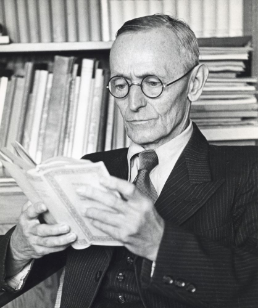
© Wikimedia / Dutch National Archives
Hermann Hesse was born in 1877 in Calw, Württemberg, and spent his childhood there and in Basel. At the turn of the century, he found employment as a bookseller and critic in the Swiss city and began writing poems. His debut novel, Peter Camenzind, brought Hesse his literary breakthrough in 1904. From 1912 to 1919, he lived with his first wife Maria Bernoulli and their three sons in Bern, where, despite serious personal ordeals, he managed to pen his landmark coming-of-age novel Demian (1919).
Immediately after moving to Ticino (Montagnola), the poet’s chosen home until his death in 1962, he wrote the novel Siddhartha (1922), an eloquent testimony to his deep connection to Indian culture and spirituality. The gloomy surrealistic Steppenwolf (1927) and the light-hearted Narziß und Goldmund (Narcissus and Goldmund (1930) further solidified Hesse’s international fame. Both writings delve deep into the human psyche and reveal its inner conflict between order and chaos, reason and passion.
Another major prose success came with Glasperlenspiel (The Glass Bead Game), which was published in Zurich in 1943. Immediately after the Second World War, Hesse was awarded the Nobel Prize for Literature (1946) for his literary legacy.
Subsequently, the poet, who had suffered from health problems throughout his life, withdrew from public life. Hesse spent his last years in the idyllic seclusion of Ticino, painting, maintaining his extensive correspondence, and devoting himself to shorter writings. He ended his eventful life as a poet in the same way he had begun it: With lyrical works. A year before his death, he had a collection of these published by Suhrkamp (Stufen).
Hermann Hesse’s books have been translated into over seventy languages and are considered one of the most read literary works of the 20th century. The main reason for this is the universal scope with which they illuminate the human condition and explore the existential search for self-discovery and self-fulfillment. Each new generation, young and old alike, rediscovers Hesse’s writings and identifies itself with their characters and themes.
Last modification 07.07.2025




Contact
Swiss National Library
Swiss Literary Archives
Benedikt
Tremp
Hallwylstrasse 15
3003
Bern
Switzerland
Phone
+41 58 467 11 05
Swiss National Library
Swiss Literary Archives
Rudolf
Probst
Hallwylstrasse 15
3003
Bern
Switzerland
Phone
+41 58 464 11 91