

In August 2025, all cow fighting competitions in Valais were cancelled indefinitely. Due to a highly contagious livestock disease, holding festivals with numerous animals from across the entire canton was deemed too risky. The tradition, which sees Hérens cows fight for the title of Queen of Queens, has been practised since the beginning of the 20th century.
Monarchy as a form of government is not terribly popular in Switzerland. Nevertheless, every three years, a wrestling king is crowned, and in the canton of Valais, a cow fighting competition is held every spring for the title “Queen of Queens”. The robust Hérens breed used in the competitions has a natural inclination to fight: herd members go head-to-head on summer alpine pastures to determine who will be the top cow.
This instinctive behaviour gave rise to cow fighting competitions, which have been held in Valais since the early 20th century. Since 2018, these cow fights have featured on the List of Living Traditions in Switzerland under the title “Animal husbandry and cow fighting”.
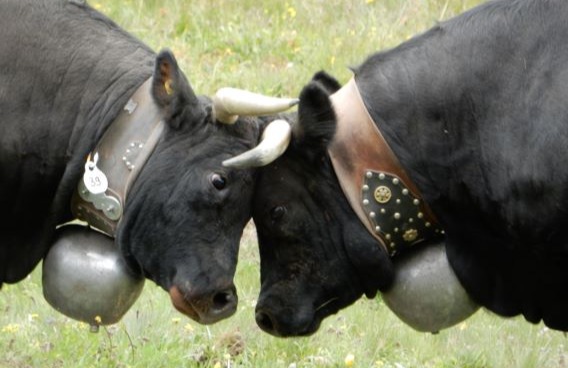

Quarrelsome but gentle
One of Europe’s oldest cattle breeds, Hérens cows take their name from the Val d'Hérens, a southern side valley in the Rhône region of Valais. The cows are only mid-sized but cut an imposing figure due to their stocky, muscular physique. Hérens cows are visually striking: They boast thick, curved horns and usually have solid-coloured coats, ranging from black to reddish-brown.
Despite their quarrelsome character, these cows are quite docile in their interactions with humans.
The breed is well suited to the climate and difficult terrain of the Alps. Compared to high-yield breeds, their milk and meat output is modest. However, the products are of high quality. Nowadays the breed is mostly kept and bred by Hérens enthusiasts.

The annual festival cycle
The season for cow fighting competitions kicks off in September and culminates in a two-day finale during one weekend in May. Ten competitions take place at alternating venues, with different local Hérens breeder cooperatives taking turns to organise the events.
The 2025 finale, which took place in Sion on 10 and 11 May, produced an unexpected champion: against all expectations, Nubie, a cow from the Eyer family of Ried-Brig, claimed the top title. In light of the longstanding rivalry between francophone Lower Valais and German-speaking Upper Valais, it should come as no surprise that Nubie’s victory was seen as a collective blow in Lower Valais.
Cows in the media spotlight
The cow fight finale is broadcast live on national television, for example by RTS. The fights also receive detailed coverage from digital and print media outlets. In his documentary film “Battle of the Queens”, Nicolas Steiner pays tribute to these pugnacious cows and the people who care for them.
The tradition of cow fighting is popular among the public. Enthusiasm for the event also brings together the two language regions of Valais, creating unity otherwise seen only during FC Sion matches.
The summer shock of 2025

This made the disappointment all the greater when the Swiss Hérens Cattle Breeding Association was forced to cancel all cow fighting competitions and the bull market in August. This drastic but unavoidable measure was taken due to the thread of lumpy skin disease (LSD). The outbreak of this highly contagious disease in France had already led to the culling of all livestock on afflicted farms.
The Hérens breed herd book contains entries for 12,000 to 13,000 animals, with around 6,000 calves born annually. For such a small population, a disease like LSD could wipe out the entire breed. The disease has not yet reached Switzerland but had come close to the French-Swiss border.
The risk of contagion was simply too high to hold events with numerous animals from all over the canton. Several thousand cows have now been vaccinated against the disease, which is nourishing hopes that the National Finale of the Queens, planned for 9 and 10 May 2026 in Pra Bardy, Sion, can go ahead as scheduled.
Bibliography and sources
- Thomas Antonietti. Animal husbandry and cow fighting. In: Living traditions in Switzerland. Federal Office of Culture FOC website
- Theresa Beitl. “Urgewalt und Sanftheit – in jeder Kuh steckt beides”. In: Walliser Bote, 15 July 2014, p. 4.
- Combats de Reines. [Advertisement]. In: Journal et feuille d’avis du Valais, 26 April 1924, p. 3
- Nicolas Gattlen (Text); Andri Pol (Photos). Kampf der Königinnen. In: Geo Schweiz, 2005, No. 10 (October), p. 1-26
- Yvonne Preiswerk; Bernard Crettaz (ed.). Das Land, wo die Kühe Königinnen sind. Translated from French and revised/supplemented by Luzius Theler. Visp: Rotten-Verlag 1992
- Swiss Hérens Cattle Breeding Association
- Ruth Seeholzer: Keine Kuhkämpfe im Wallis wegen LSD, in: Radio SRF: Regionaljournal Bern Freiburg Wallis, 21 August 2025
Films / videos
- Jean-Pierre Clavien. Vive les reines: une race en péril. Télévision Suisse Romande TSR, 12 February 1986
- Ringkuhkämpfe – der Kampf der Königinnen. Fernsehen SRF, Tagesschau from 5 May 2019
- RTS Radio Télevision Suisse. Combats des Reines. Retransmission annuelle de la grande finale nationale de la Race d'Hérens.
- Nicolas Steiner. Battle of the Queens. Documentary from 2011
- Linus van Moorsel. Kuhkämpfe im Wallis: Tradition oder unmoralisches Spektakel? Fernsehen SRF, “SRF Impact” from 1 September 2022
Last modification 03.11.2025




Contact
Swiss National Library
SwissInfoDesk
User services
Hallwylstrasse 15
3003
Bern
Switzerland
Phone
+41 58 462 89 35