
‘A Wonderful World’ by Niklaus Stauss
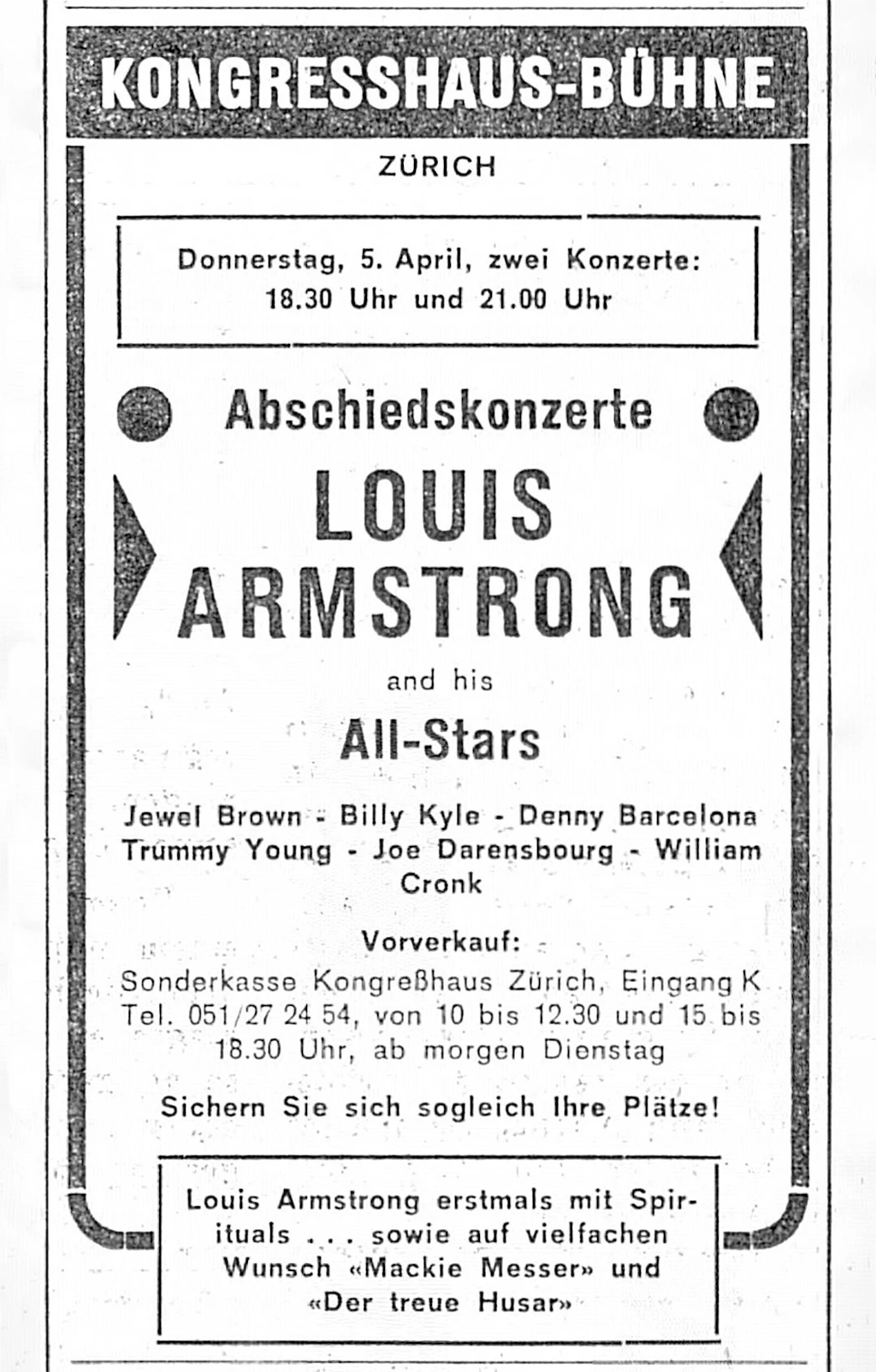
Based in Zurich, Niklaus Stauss (*1938) has photographed all the big names from the world of culture since the late 1950s. His photos reveal a unique perspective and a spontaneous approach to photography. Through his pictures, he takes us behind the scenes of a concert by “Louis Armstrong and His All Stars” at Zurich’s Kongresshalle. Take a look at this selection of photographs and allow yourself to be transported back to the jazz age, right to the heart of this event on 5 April 1962.
By Juliette Berthoud
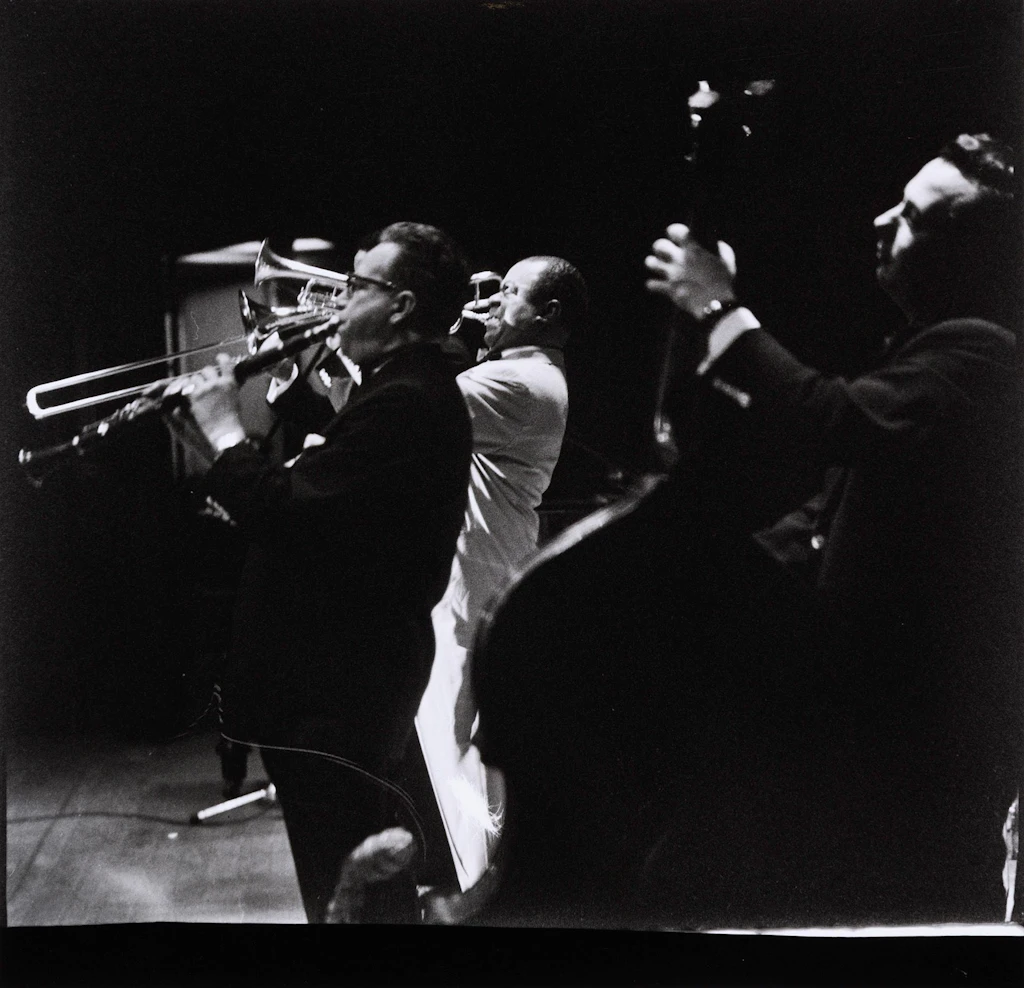
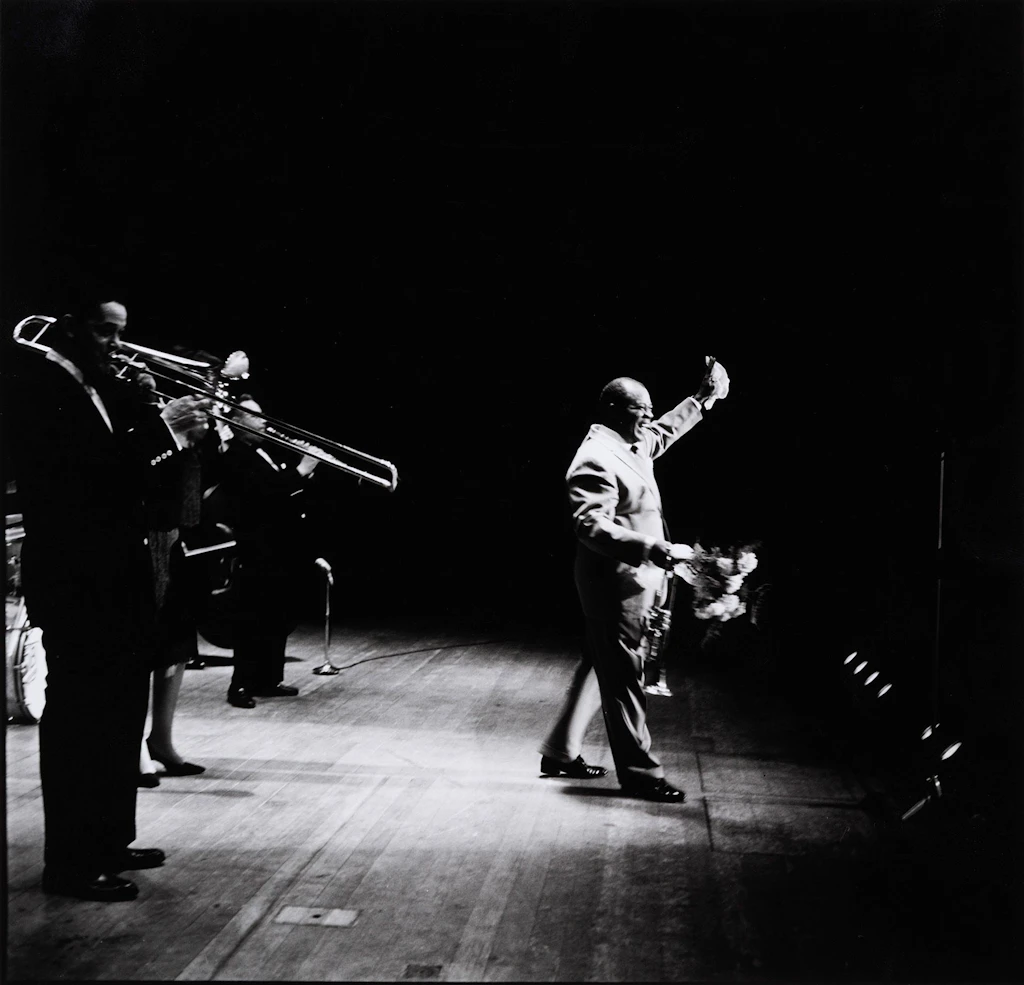
In the early 1960s, Louis Armstrong (1901–71) was touring all over the world. His big band was highly sought after for concerts, particularly between 1961 and 1967. It was during this period that the group recorded several of their biggest successes, including ‘Hello Dolly!’ in 1964 and ‘What a Wonderful World’ in 1967. Armstrong was at the height of his fame when he came to Switzerland for two performances in Zurich. Conversely, the young Niklaus Stauss was just starting out in his career when he attended one of their concerts on the stage of Zurich’s Kongresshaus. At the time, Stauss was working as a freelance photographer for the Keystone press agency. Aged just 24, he took some sensational shots, which immortalise the group’s energy and stage presence.
An artist backed by a stellar band
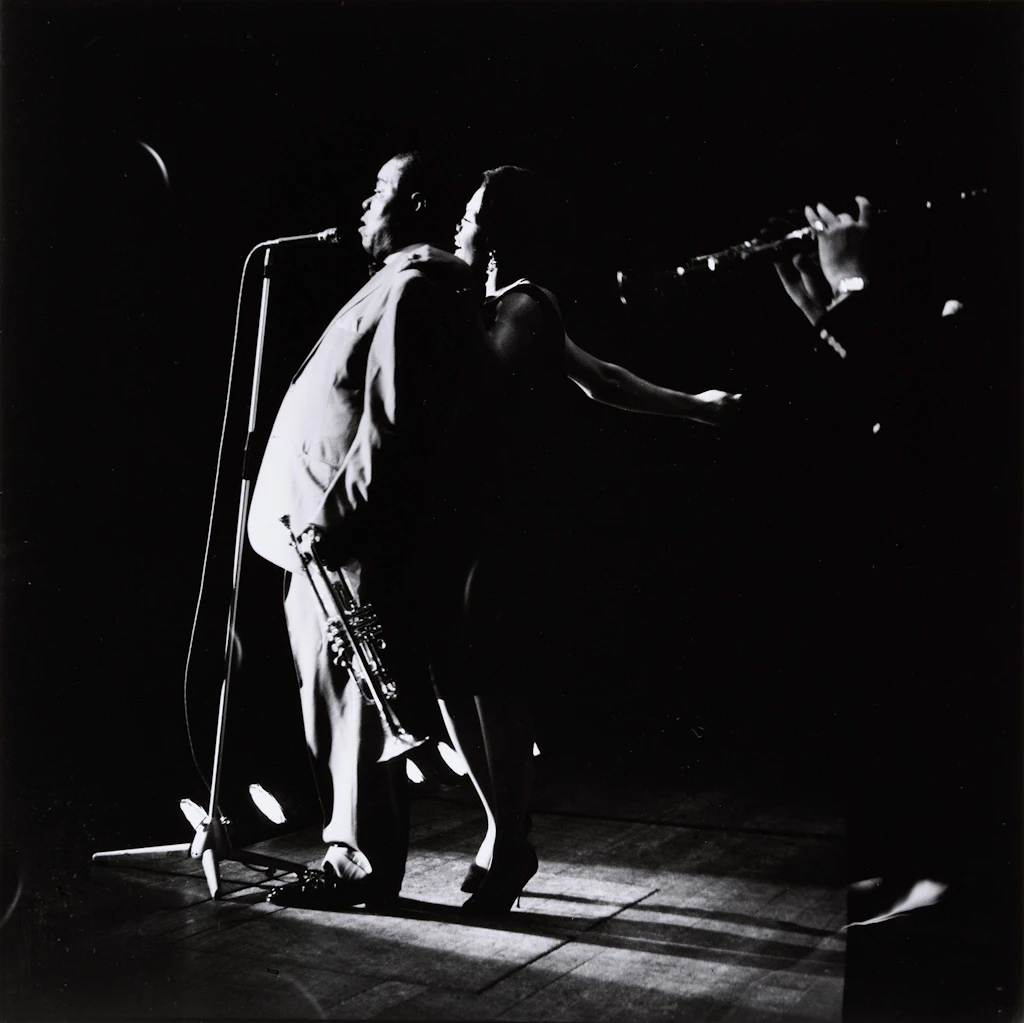
At the concert, Niklaus Stauss photographed the artists in action, giving the viewer a front-row seat. He chose an original perspective by capturing this moment from the backstage area of the concert hall and skilfully using light to structure the image. It is interesting to note that he does not photograph Louis Armstrong alone, but surrounded by his “All Stars”. In this photo, Armstrong shares the microphone with American singer Jewel Brown. They are facing in the same direction and are illuminated by the spotlights. The movement of Brown’s arm lends the picture a certain dynamism and mirrors the beam of light on the stage floor. On the right, we can make out a clarinet, probably played by Joe Darensbourg. While Stauss does not place Armstrong in the centre of the image, he remains the central figure thanks to the way in which the lighting makes him stand out, leaving Brown and Darensbourg in his shadow.
A unique perspective
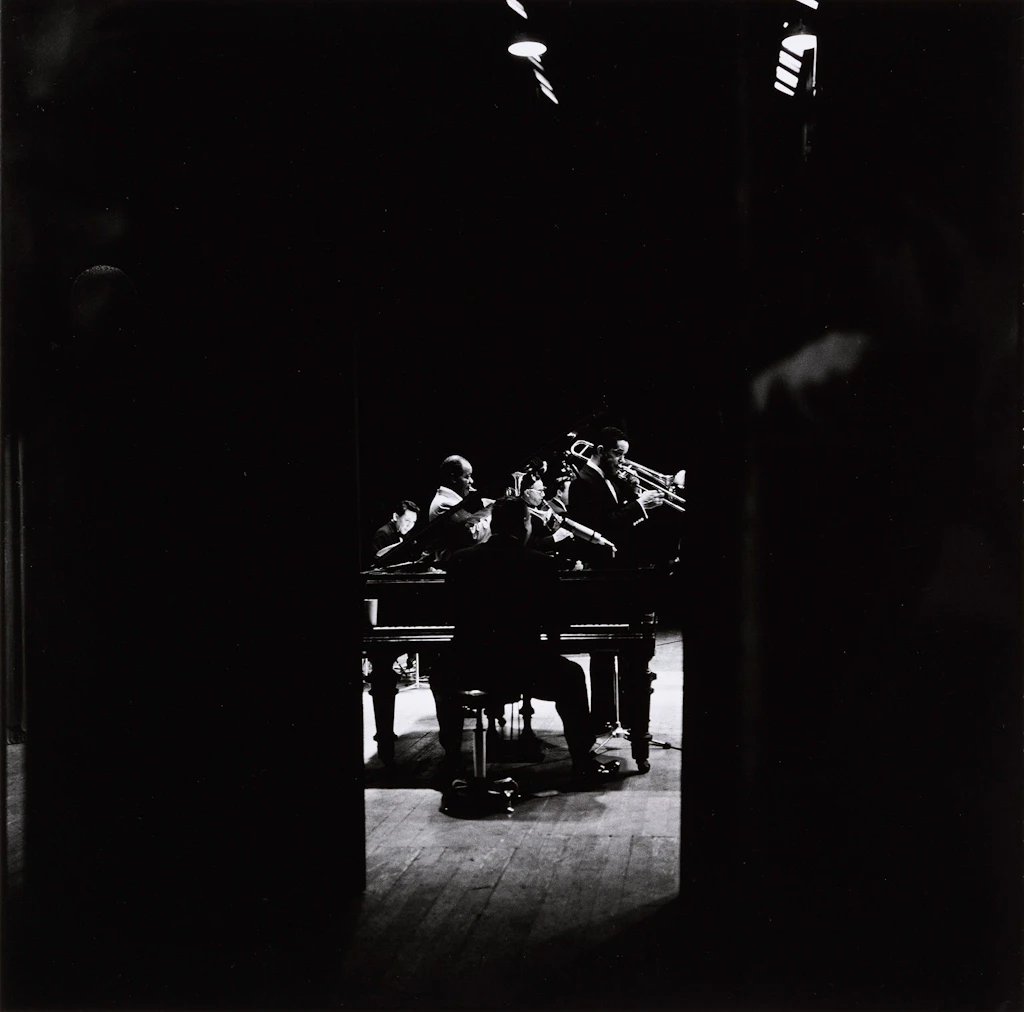
This selection of photographs reveals Stauss’ unique and unusual perspective. By photographing the concert from backstage, Niklaus Stauss transports us to the heart of the action, in a privileged spot that is not usually accessible to the public. In this way, we almost feel part of the big band. In addition, this behind-the-scenes shot reveals a certain boldness on the part of the photographer. He structures the composition using the backstage curtains – elements that are usually overlooked in perspective. Because they serve to focus attention on the stage, our eye does not normally pay attention to them. Stauss uses them here in their original function to create a frame within the photograph, thereby providing a close-up of the group of musicians like a zoom. Finally, the curtains darken the image and create a contrast with the light projected onto the stage, which guides our gaze to the group of musicians and in particular to Louis Armstrong, standing out in his white suit. Once again, he remains the main subject of the image although the photographer does not place him at the forefront.
Niklaus Stauss meets Louis Armstrong
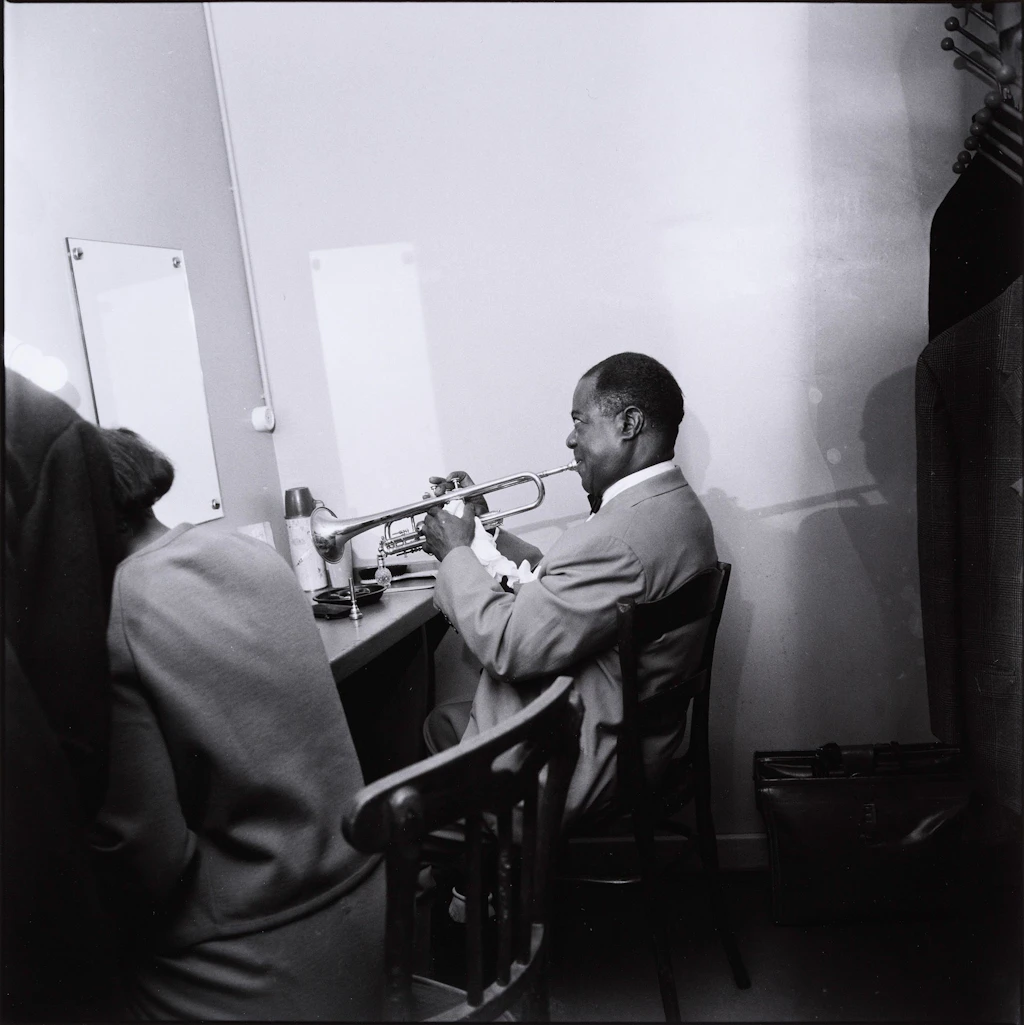
This portrait of Louis Armstrong in his dressing room is one of Stauss’ most famous photos. The originality of this shot comes from its candid, unposed quality. Armstrong is seated in front of a mirror playing his trumpet, is sitting in profile in relation to the photographer, is not looking at the camera and the photo seems to capture him in an unguarded moment.
In his book ‘Foto: Niklaus Stauss : Mit der Kamera unterwegs seit 1950’, the photographer recounts how this encounter with Armstrong was unplanned. Stauss simply approached the artist after the concert and ended up taking his photo in the dressing room. Niklaus Stauss describes an age when “everything was freer and simpler” (p.40) and it is precisely this spontaneity that makes his photos so unique.
Niklaus Stauss was born in Lichtensteig (SG) on 27 January 1938. He trained at Zurich School of Arts and Crafts and was a freelance photographer for Keystone Press Zurich from 1955 to 1959. He opened his first studio in 1961 and later founded the press agency Photo Presseagentur, and the Kunst+Kultur archives (PPK+K) in 1985. He subsequently worked as official photographer at the Theater am Neumarkt in Zurich from 1989 to 1993, and participated in many exhibitions over the course of his career. He has been taking photos all his life, capturing social, artistic and cultural life in Switzerland and abroad, between the 1950s and 2010.
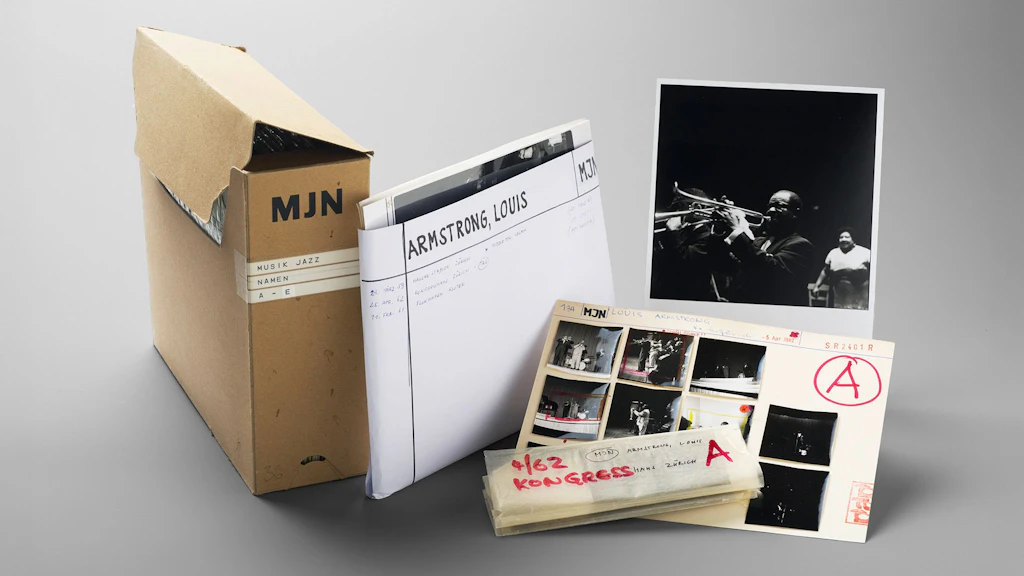
The Prints and Drawings Department at the Swiss National Library acquired all of the photographer’s archives in 2011. The holdings are estimated to include over 50,000 documents – mainly analogue photos in black and white, slide decks, contact sheets and prints.
Bibliography and sources
- ‘Louis Armstrong’. Wikipedia article [consulted on 16.06.2026]
- Barbara Stauss (ed,): Foto: Niklaus Stauss: Mit der Kamera unterwegs seit 1950, Zurich: Edition Patrick Frey, 2018
- Claudia Herzog: Ein Zürcher fotografiert die Stars – seit 60 Jahren. In: SRF Schweizer Radio und Fernsehen, 2018 [consulted on 16.06.2026]
- Ilse Storb et al.: Louis Armstrong: The Definitive Biography, Bern: P. Lang, 1999
Swiss National Library
Hallwylstrasse 15
3003 Bern