
In search of vertical waters
The pioneers of Swiss landscape painting focused on waterfalls as a motif as early as the 18th and 19th centuries. The Staubbach Falls and other “vertical waters” featured not only in countless travel accounts, literary works and photo essays, but also adorned the posters of tourism organisations in Switzerland and abroad to promote their destinations and invite travellers to experience the extraordinary. Digitised works from the National Library let us step inside this visual world.
A beloved motif for paintings
On a calm lake, water stretches out over the horizon, but a cascading waterfall presents the same element on a vertical plane – albeit only for the brief moment of its freefall. This fleeting quality is part of what makes waterfalls so fascinating. Their often spectacular beauty was admired and extolled as far back as the pioneering days of tourism – not only in words but also in paintings.
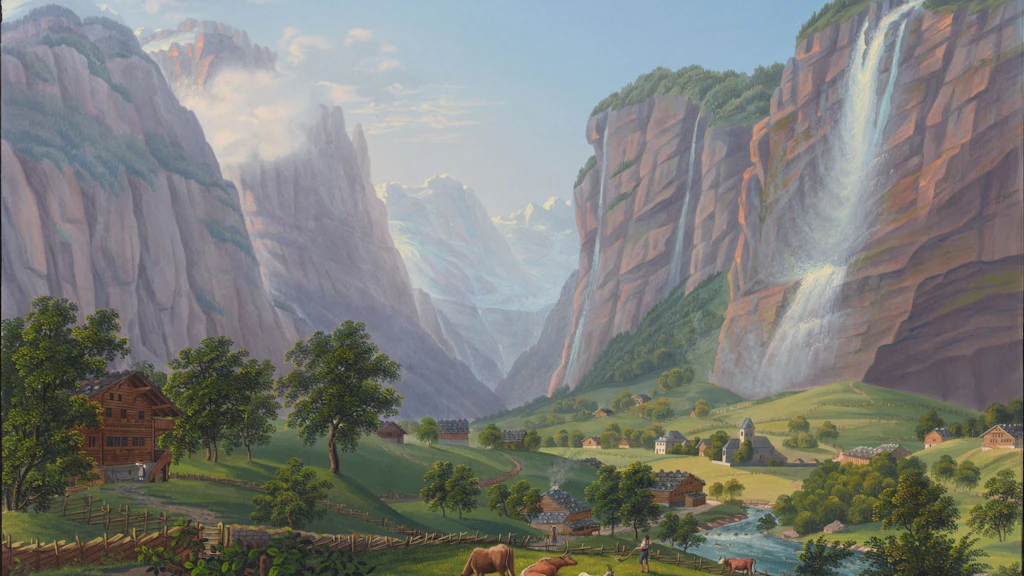
In the 18th and 19th centuries, Swiss Little Masters produced depictions of landscapes and towns, scenes from everyday life and studies of traditional dress for a growing tourist market. Waterfalls were a popular subject, as exemplified by Johann Heinrich Bleuler the Younger’s (1787–1857) 1836 painting “Der Staubbach im Lauterbrunnenthal”. The Gugelmann Collection, donated to the Swiss National Library in 1978, consists chiefly of works in this genre. The NL has digitised the collection and made the high-resolution images available online via Wikimedia Commons.
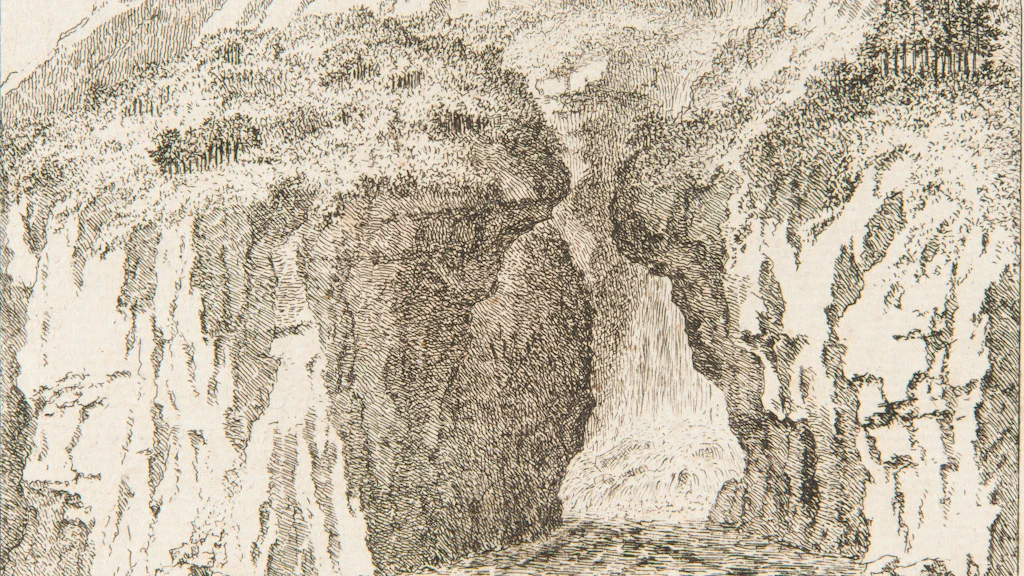
The Staubbach Falls in the Lauterbrunnen Valley is the highest free-falling waterfall in Switzerland. However, making a ranking of waterfalls is no straightforward matter. First of all, it is difficult to measure the total drop on difficult to access terrain. Another issue is that what counts as a “tall” waterfall depends on how one defines a “waterfall” in the first place. If not all the water has to be in free fall, the Staubbach can claim first place. But in other rankings, it comes third, behind the Mürrenbach Falls (also in the Lauterbrunnen Valley) and the Seerenbach Falls on Lake Walen.
The mightiest in mainland Europe
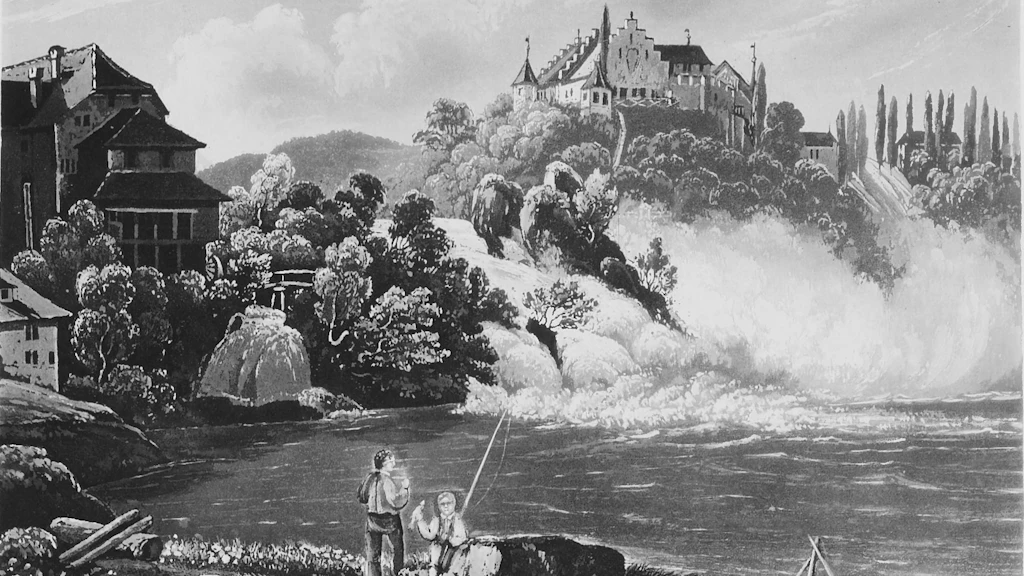
The album “Malerische Reise rund um den Rheinfall” (“Picturesque Journey around the Rhine Falls”) was compiled by Johann Ludwig Bleuler (1792–1850), Johann Heinrich’s younger brother. In the Rhine Falls, the artist chose a subject that was as beloved as it was popular – both a destination for travellers and a motif for the drawings in his album. Visual art wasn’t the only genre where the Rhine Falls shined: they are also described and promoted in a wealth of travel books. These books can be digitised in full on request (E-Book on Demand) if are no longer protected by copyright and have fallen into the public domain.
Engineering the natural world
As early as the 19th century, up-and-coming tourist resorts, hotels and guesthouses were using waterfalls and other natural wonders to attract visitors from near and far. It didn’t take long for the tourism industry to try to boost the appeal of the destination itself, whether by offering additional attractions or by engineering the setting, a trend that continues to this day with features such as suspension bridges, viewing platforms and scooter descent trails. One pioneer of these engineered add-ons was Carl Hauser-Blattman, owner of the Grand Hotel Giessbach, which opened in 1875. He commissioned the construction of the Giessbach Railway, which in 1879 became Switzerland’s first funicular built purely for tourism.
Posters: the rise of large-format advertising
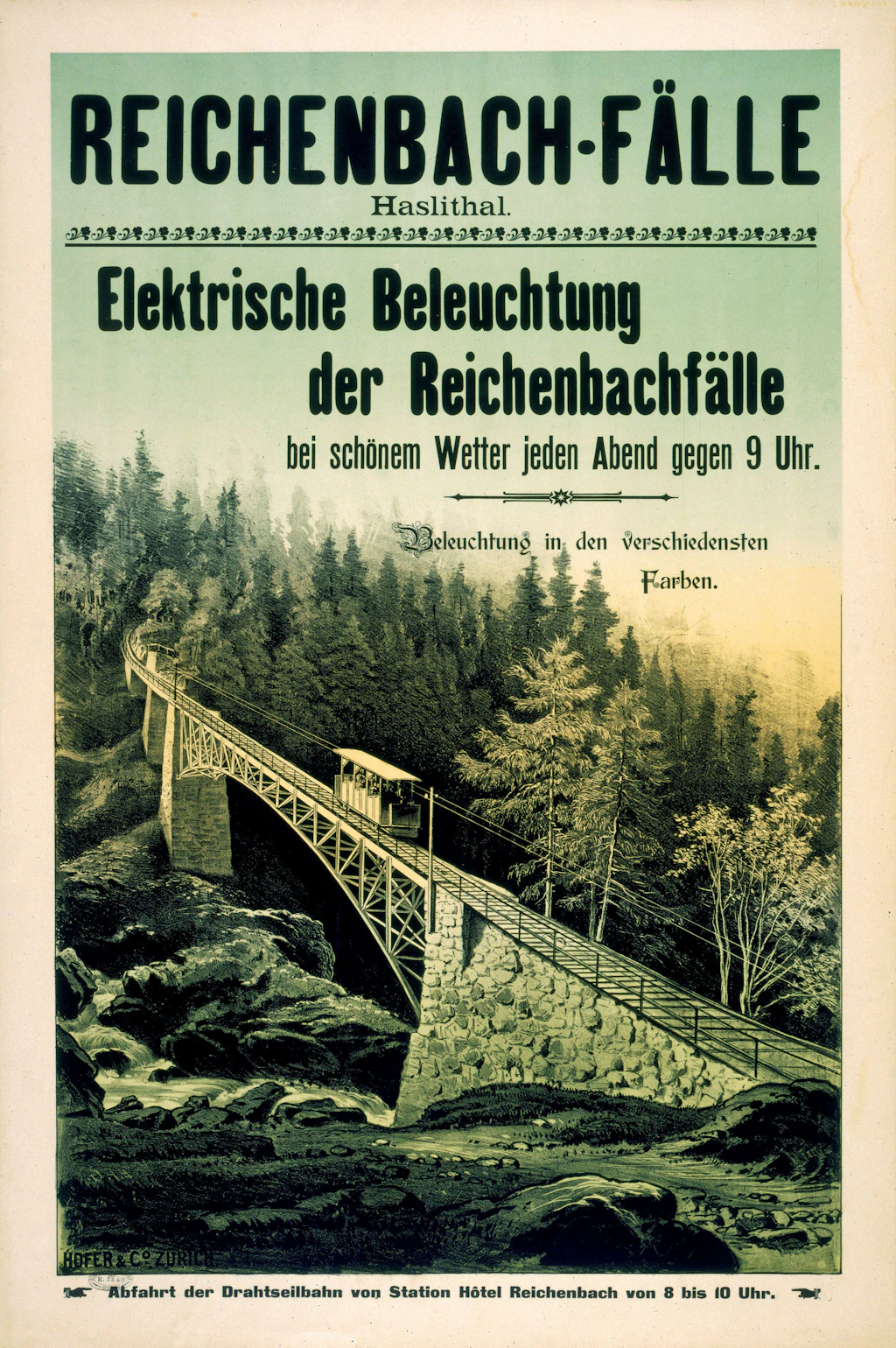
In 1899, the Reichenbach Falls Funicular was inaugurated as Switzerland’s 23rd funicular railway. To this day, it provides access to a place shrouded in mythology: the Reichenbach Falls. The waterfall owes its fame to detective Sherlock Holmes. In 1893, author Sir Arthur Conan Doyle chose this spectacular setting for the detective’s (seeming) death, sending him plunging to his doom during a fight with Professor Moriarty in the story The Final Problem.
Sherlock Holmes’s literary fate transformed the perception of this wild and romantic waterfall, turning it into a mysterious, almost uncanny place of doom whose dark allure was felt most keenly in the cover of night. This prompted railway owners to offer evening rides while illuminating the Reichenbach Falls with electric lights. A poster with a moody colour scheme was presumably intended to attract people with a taste for the eerie – though with little financial success: on 20 February 1903, the Federal Supreme Court ordered the railway to be liquidated. This poster and many others from the genre are housed in the NL’s Prints and Drawings Collection.
Image sources and literature
- Bleuler the Younger, Johann Heinrich: Staubbach im Lauterbrunnenthal, 1836 (Wikimedia CC)
- Bleuler, Johann Ludwig: Vue de la Chûte du Rhin prise des forges. In: Voyage pitoresque au tour de la Chûte du Rhin [sic], dessiné d'après nature par E. (= Aegidius) Federlé, publ. par Johann Ludwig Bleuler, c. 1835
- Bleuler, Johann Ludwig: Vue de la Chûte du Rhin prise des forges. In: Voyage pitoresque au tour de la Chûte du Rhin [sic], dessiné d'après nature par E. (= Aegidius) Federlé, publ. par Johann Ludwig Bleuler, c. 1835. digitised version
- Geisser, Marcus; Guy Marriott; Michael A. Meer (eds.): Sherlock Holmes, Arthur Conan Doyle and Switzerland. Serious and less serious musings from The Reichenbach Irregulars of Switzerland, Norderstedt: Books on Demand, 2021
- Gessner, Salomon: Winter-Loch am Wallenstadter See (part of the Seerenbach Falls), 1785 (Wikimedia CC)
- Gugelmann Collection on Wikimedia Commons
- HelveticAll: Search for publications on the Rheinfall, Chute(s) du Rhin, Cascate del Reno and Rhine Falls (DE, FR, IT, EN)
- HelveticAll: Search for publications on the Staubbach, Mürrenbach, Giessbach and Seerenbach Falls
- Helveticat: Search for publications on Sherlock Holmes (all languages)
- Reichenbach-Fälle, Haslithal, Zürich: Hofer & Co., ca. 1900
- Slater, Julia; Waterfalls fall from their heights. In: swissinfo.ch, November 30, 2009
- The Gugelmann Collection, prints from the 18th / 19th centuries
Swiss National Library
User services
Hallwylstrasse 15
3003 Bern