
In search of new touristic shores
In the 19th century, steamships and railways transformed travel into a fast and comfortable affair. As modern forms of mass transport, they not only connected cities but also opened up tourism to previously remote areas – a development further accelerated by the expansion of additional transport networks. The steamship services on Lake Thun and Lake Brienz illustrate this well: here, travel by ship long remained an important means of getting around.
“Discovering” the Bernese Oberland
The Bernese Oberland long had a reputation for scenic beauty, shaped in part by poems such as “The Alps” (1729) by Albrecht von Haller and early travel guides written by and for the upper classes. The authors were mostly men who had both the time and the means to explore the mountains and publish their experiences.
In the early 19th century, improved road connections between towns, combined with a new system of frequent horse changes, allowed travellers to cover a lot more ground by using the infrastructure for express mail. The journey from Geneva to Bern, for instance, could now be completed within a single day rather than three.
Steamships drive tourism
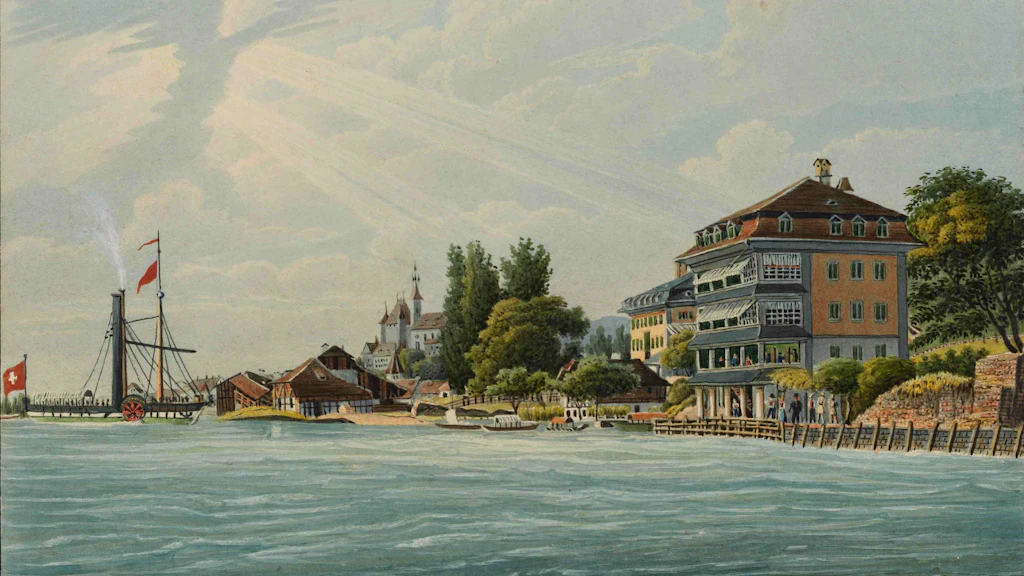
Once steamships were introduced to Switzerland’s biggest lakes in 1823 – first in wood, later in iron – visitor numbers grew considerably, especially in the mountain regions of the Bernese Oberland. The most convenient way to reach this area had always been via the lakes of Thun and Brienz, but steamships definitely made the journey faster and more comfortable than it had been with sailing or rowing boats.
Lake Thun received its first steamship in 1835, with Lake Brienz following suit in 1839. Business owners in the hospitality and hotel sector initiated both ventures, as they had a vested interested in the growth of the tourism industry.
Railways fuel the boom
Tourism in the Bernese Oberland received a further boost once Bern and Thun were connected to the international rail network, in 1857-58 and 1859, respectively. Steamship passenger numbers reflected this development, climbing from roughly 80,000 to 130,000 by 1861. Meanwhile, the canton of Bern continued building main roads throughout the Oberland region, helping tourism spread into the valleys as well.
In 1844, before any railway connection existed, Karl Baedeker (1801-1859) advised the readers of his Swiss travel guide how to see the Bernese Oberland in three days if they were short on time: Bern to Grindelwald, Grindelwald to Meiringen, and Meiringen to Brienz and then back to Bern.
The Bernese Oberland in a single day
Just like in a modern travel guide, Baedeker proposed a one-day itinerary for travellers with time constraints who nonetheless wished to experience the highlights of the Bernese Oberland: depart Bern for Thun by express coach at 5 a.m. (three hours), then board a steamship (!) bound for Neuhaus at 9 a.m. (in the municipality of Interlaken) – a ninety-minute crossing – before continuing via Unterseen to Lauterbrunnen to see the Staubbach Falls.
The idea was for tourists to stop in Interlaken for lunch. To be back in Bern by 9 p.m., as Baedeker suggested, travellers needed to board the steamship at Neuhaus at half past three and then catch the express coach for Bern at 6 o'clock.
Expansion of transport networks drives tourism
By 1912, the fleet had grown steadily to eight vessels on Lake Thun and four on Lake Brienz. Starting in 1869, the enterprise was run by the Vereinigte Dampfschifffahrt-Gesellschaft für den Thuner- und Brienzersee (United Steamship Company for Lake Thun and Lake Brienz), which was later taken over by the BLS in 1912. During this period, passenger numbers experienced remarkable growth, climbing from roughly 25,000 to a staggering 1,232,000.
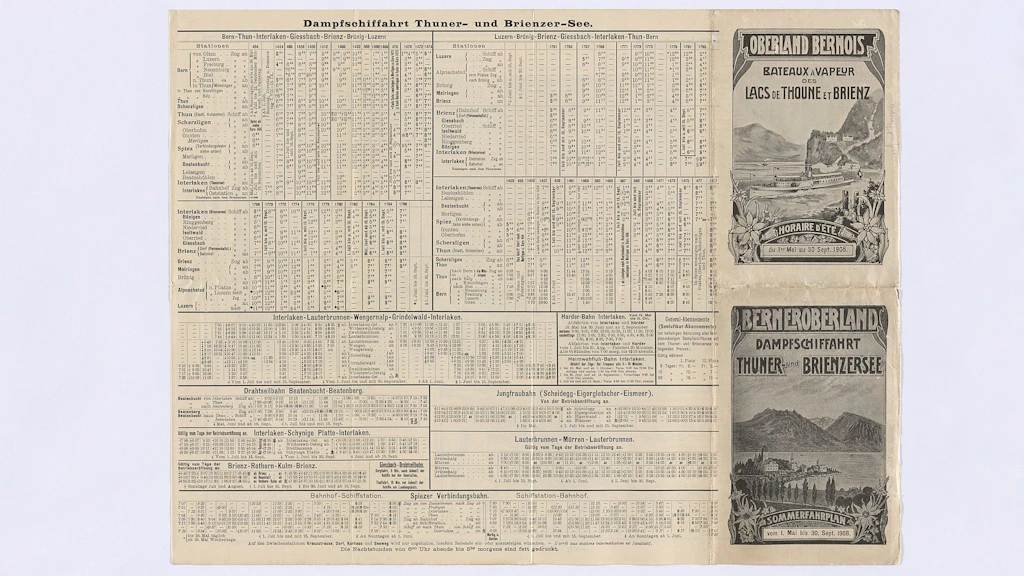
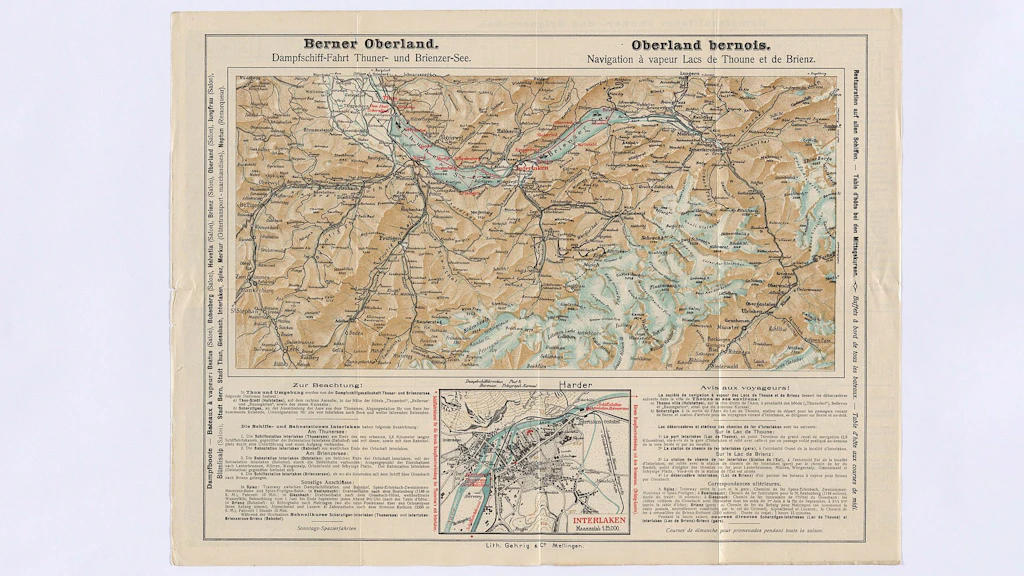
This surge was a direct outgrowth of a major expansion of the transport network (railways, mountain rail and toothed rack rail) that had taken place over the previous years. Steamship services continued to play a central role in Bernese Oberland tourism, which a brochure from 1908 clearly illustrates: the front displays a map of the steamship routes, while the back shows timetables for all connecting rail services, the boats on Lake Lucerne included.
Bibliography and sources
- Baedeker Karl. Die Schweiz : Handbüchlein für Reisende, nach eigener Anschauung und den besten Hülfsquellen bearbeitet. Mit einer Reisekarte und einer Alpen-Ansicht vom Rigi. Koblenz: Baedeker, 1844
- Baedeker Karl. Die Schweiz : Handbüchlein für Reisende, nach eigener Anschauung und den besten Hülfsquellen bearbeitet. Mit einer Reisekarte und einer Alpen-Ansicht vom Rigi. Koblenz: Baedeker, 1844 (Digitised by the Bayerische Staatsbibliothek)
- Collected documents of the “Vereinigte Dampfschifffahrt-Gesellschaft für den Thuner- und Brienzersee” in the NL’s online catalogue, call number V 4344
- History of BLS Navigation, BLS website (last accessed on 06.02.2026)
- Meister Jürg, Liechti Erich. Die Geschichte der Schifffahrt auf dem Thuner- und Brienzersee. Thun/Gwatt: Weberverlag.ch, 2021
- Meister Jürg. 200 Jahre Dampfschifffahrt in der Schweiz. Thun/Gwatt: Weberverlag.ch, 2023
- Oppermann Wilhelm Ulrich: Hôtel et pension Bellevue près Thoune, ca. 1836-1840 (Wikipedia CC)
- Reichen Quirinus. Per Bahn in die Berge. In: Berner Zeitschrift für Geschichte, 2019, No. 3, p. 85-101
- Schiedt Hans-Ulrich, Schifffahrt. In: Historisches Lexikon der Schweiz, online edition (as of 2012)
- Schiedt Hans-Ulrich. Zu Fuss, mit Pferd oder Schiff : Verkehr und Tourismus im Berner Oberland vor der Eisenbahn. In: Berner Zeitschrift für Geschichte, 2019, No. 3, p. 63-84
- Tissot Laurent, Tourismus. In: Historisches Lexikon der Schweiz, online edition (as of 2022)
- Vischer Daniel. Schiffe, Flösse und Schwemmholz : unterwegs auf Schweizer Gewässern : eine Technikgeschichte. Baden: Hier und Jetzt, Verlag für Kultur und Geschichte, 2015
Foldable brochure, “Berner Oberland, Dampfschiffahrt Thuner- und Brienzersee” (1908), from the collection of tourism brochures held by the Schweizerische Verkehrszentrale (today: Switzerland Tourism), call number V 4800 (not listed in online catalogue)
Swiss National Library
User services
Hallwylstrasse 15
3003 Bern