

A picture is a picture is a picture
501 portraits, 4 groups of works and 50 series spanning 30 years: these figures describe the multi-year photography project and lavish portfolio of photographer Christian Scholz (*1951). The project, which centred on portraits of people from his adopted home of Switzerland, reached its provisional conclusion in 2020. A limited edition of the project entitled “501 – Corpus of Portraits Switzerland. An artistic programm” will be donated to the Swiss National Library in 2026. Below, we explore the work and the artist through three selected portraits.
By Kathrin Gurtner
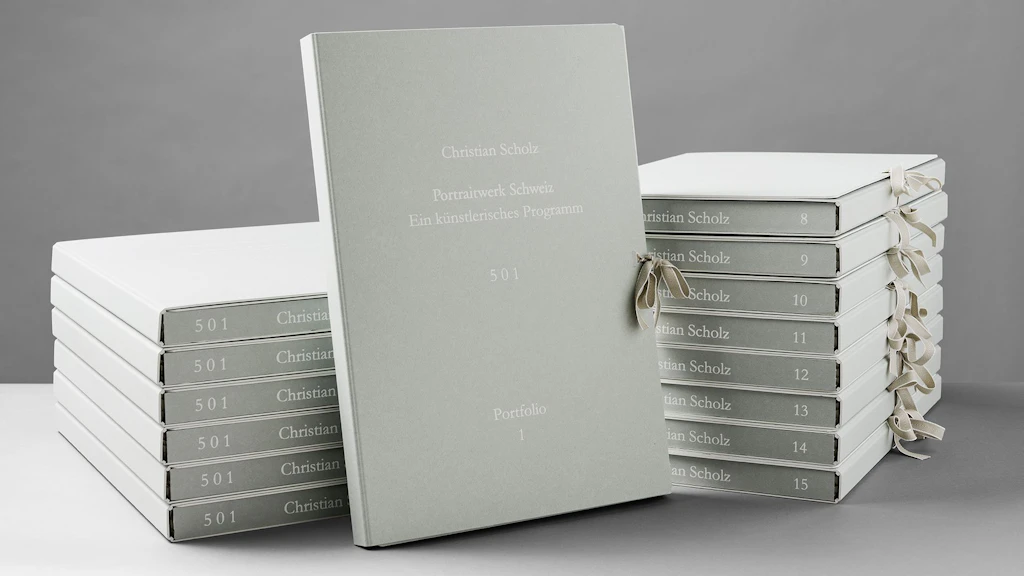
Drawing on Gertrude Stein’s famous line “a rose is a rose is a rose”, Christian Scholz has adopted “a picture is a picture is a picture” as his artist's motto (in: Scholz, Christian, 2018, p. 21). This maxim guides his creative process: Scholz neither retouches his photographs nor crops them, placing the primacy of the image and its immediate impact at the centre. With his “Corpus of Portraits Switzerland” series, his primary aim was not to create a visual atlas of national identity – rather, he was far more interested in the project as a long-term undertaking an
“To create a true picture of our age, with absolute fidelity to nature” (August Sander, 1927)
With his “almost encyclopaedic endeavour” (Roger Fayet, Director of SIK-ISEA, Zurich) spanning three decades from 1990 to 2020, Scholz situates himself within the tradition of the great portraits in photographic history, particularly the epoch-defining project “Menschen des 20. Jahrhunderts” (People of the Twentieth Century) by August Sander (1876–1964). Sander created a snapshot of his era through photographs of people from every walk of life that were rendered “with absolute fidelity to nature”. He arranged the photographs by theme into folders and groups of works.
The conceptual affinity between Scholz and Sander is immediately striking. Scholz’s edition comprises 501 portraits, which he likewise organises into different groups and series. At the heart of this photographic undertaking is the ambition to present the subjects as authentically as possible, in all of their individuality. Scholz photographs in black and white. His subtle handling of light and shadow allows him to approach his subjects with great sensitivity.
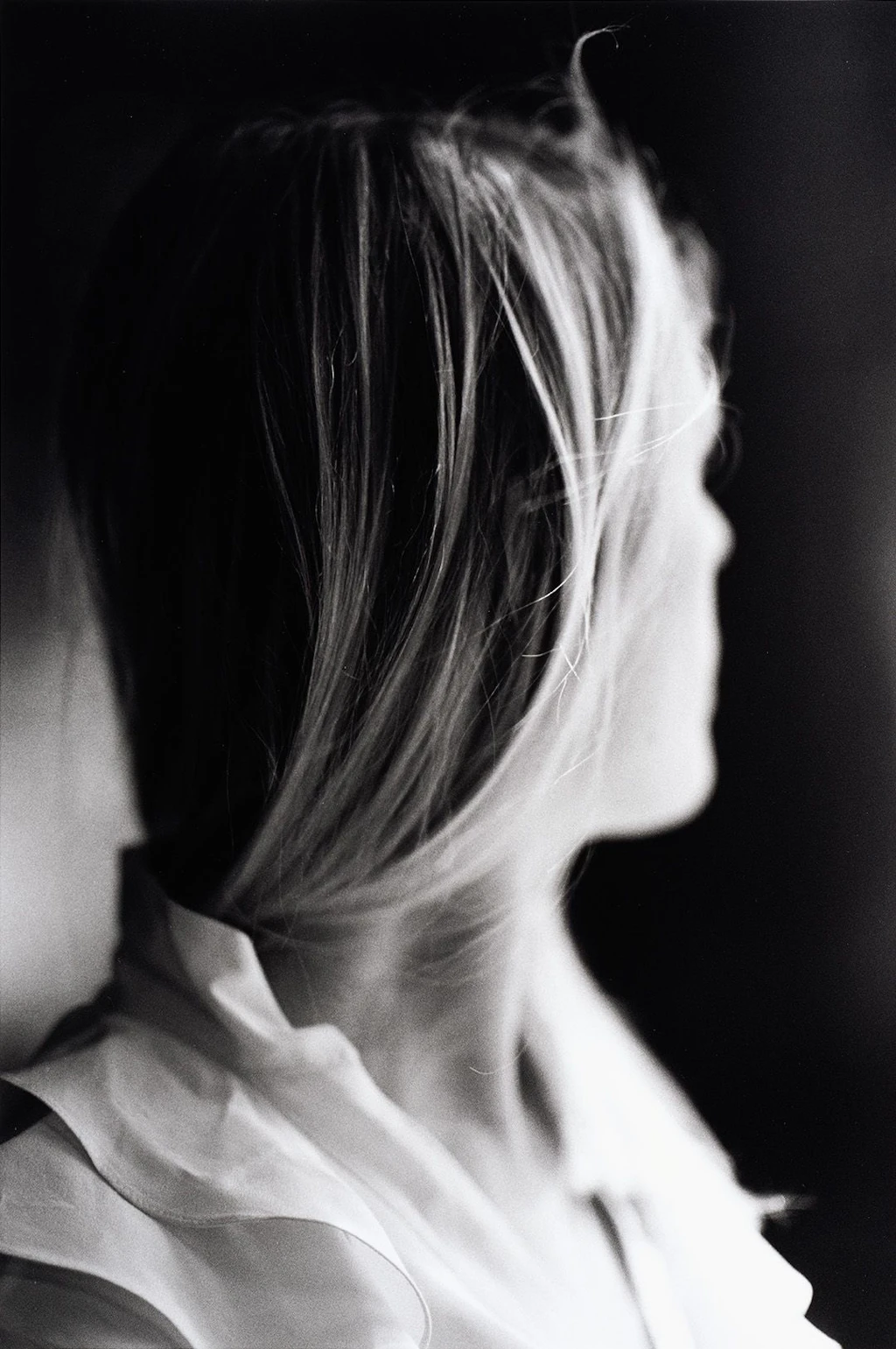
Tatyana Franck: portrait from behind
This subtlety is exemplified by the portrait of Tatyana Franck, which captivates the viewer with a quiet intensity. The slightly turned position of body and face lend the image an air of mystery. This is achieved mainly because Christian Scholz works with an analogue camera while forgoing a tripod, which allows him to enter into immediate contact with his subject.
The visual space is tightly framed, yet the interplay of focus and bokeh, and the transition from light to dark, give the image an impressive sense of depth. Light is an important compositional tool for Scholz: thanks to specialist lenses, he can photograph even in difficult lighting conditions without artificial light. This lends his portraits a sense of naturalness and a quality reminiscent of portrait painting.
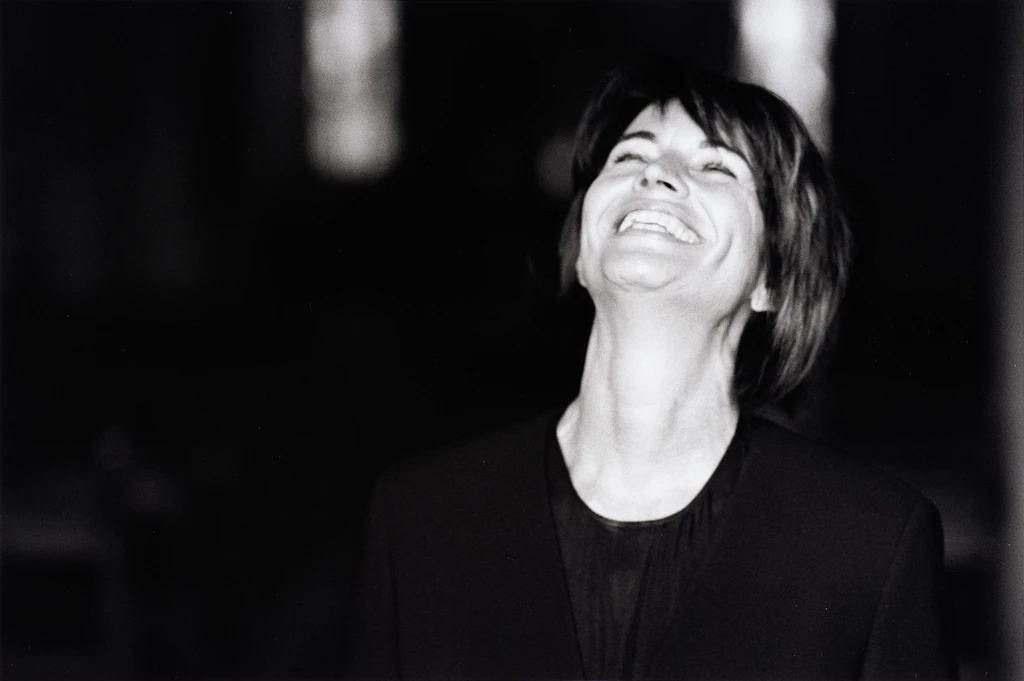
Doris Leuthard and “the laughter of women”
The portrait of Doris Leuthard is spaciously composed, with black dominating the frame. Only the face and neck, together with two bright areas in the background, emerge clearly from the darkness. Once again, the sense of depth is enhanced through sharp contours in the foreground set against an out-of-focus background.
The photograph shows the subject in a relaxed mood. She throws her head back and laughs, keeping her eyes closed. The snapshot quality of the image, the unusual angle and the moment of laughter lend the work a powerful dynamism. This is heightened further by the bright vertical columns in the background, which provide a static counterpoint to the movement in the foreground.
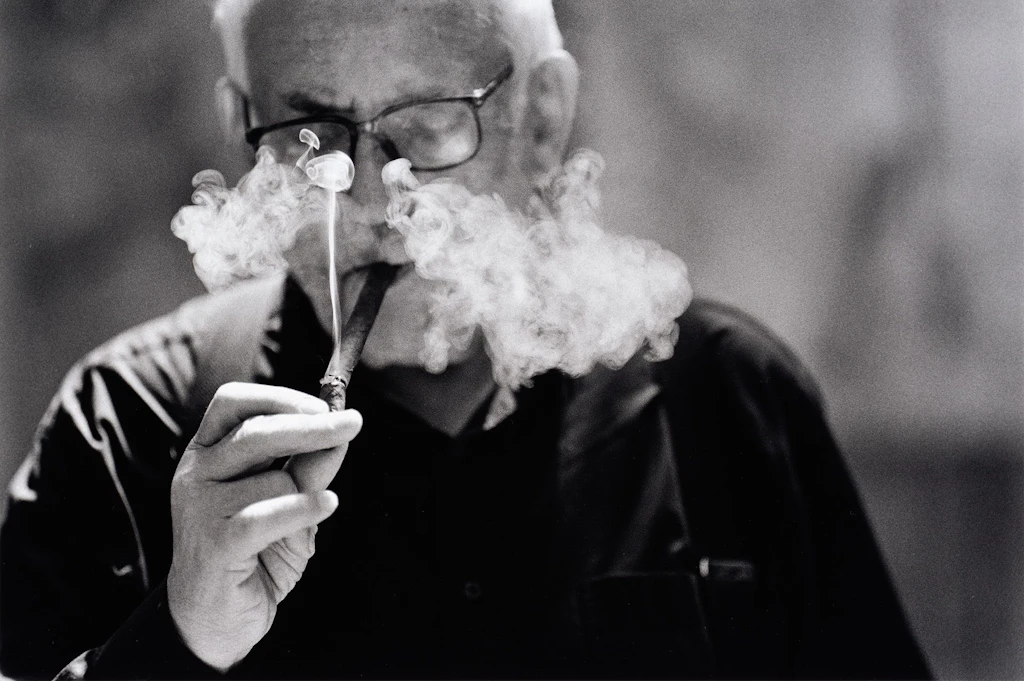
Visage and hand: Hans Josephson
With the series “Antlitz und Hand” (“Visage and Hand”), Scholz makes a two-pronged reference to August Sander. First, the title echoes Sander’s 1929 work “Antlitz der Zeit. 60 Aufnahmen deutscher Menschen des 20. Jahrhunderts” (“Visages of Our Time: Sixty Portraits of Twentieth-Century Germans”); second, Scholz creates a visual affinity with Sander by foregrounding the hand as an essential element of photographic composition.
In the portrait of Hans Josephson, the subject’s hand is brightly lit and sharply defined in the foreground. His face recedes into the background, out of focus and partially cropped. In the centre of the image, wafting cigar smoke marks the transition from foreground to background. By photographing Josephson – an artist who worked with rough, heavy bronze sculptures – through a veil of pale smoke, Scholz creates an intriguing tension between the fleeting and the material.
Christian Scholz was born in Stockholm in 1951. In 1977, he completed his degree in literary studies at the Freie Universität Berlin with distinction. In 2014, he was granted Swiss citizenship. He has lived and worked in Zurich since 1985. He is a self-taught analogue photographer. His work is held in numerous public and private collections, including at Photo Elysée Lausanne, Kunsthaus Zurich, MASI Lugano, the National Portrait Gallery in London and many more. His photographic works have been exhibited widely, both in Switzerland and abroad.
Bibliography and sources
Swiss National Library
Hallwylstrasse 15
3003 Bern